
WILDLIFE REMOVAL
Wildlife Removal in Toronto, Oakville and the GTA
Raccoons, squirrels, skunks, bats, snakes, opossums and groundhogs, removed and sealed out, plus bird control. Serving Toronto, Oakville, Mississauga, Burlington and Milton.
WHAT’S ACTIVE WHEN
The Ontario Wildlife Year
Most wildlife problems follow the calendar. Here’s what moves in, and when.
Sep to Nov
Fall
Squirrels and raccoons move into attics ahead of winter. Skunk activity peaks in September as the year's young set out on their own. From mid-September to the end of November, once their young can fly, bats can be sealed out with one-way doors.
Dec to Mar
Winter
Raccoon mating season. Females look for a warm attic or chimney to den in ahead of spring litters. Squirrels stay active all winter. Bats are hibernating, so there is no bat exclusion from December to the end of March: a bat shut out of a building in winter will likely die.
Apr to May
Spring
Raccoon kits and squirrel litters arrive, and a mother trapped or sealed out of the attic leaves her young stuck inside. Bats can be excluded in April and early May, before their pups are born. Groundhogs wake and dig under sheds and decks, and birds start nesting in vents.
Jun to Aug
Summer
Raccoon activity peaks. Bats are raising young that cannot fly yet, so exclusion waits until mid-September. Skunks settle under decks and porches.
WHAT TO LOOK FOR
Signs of Wildlife, Animal by Animal
Raccoons
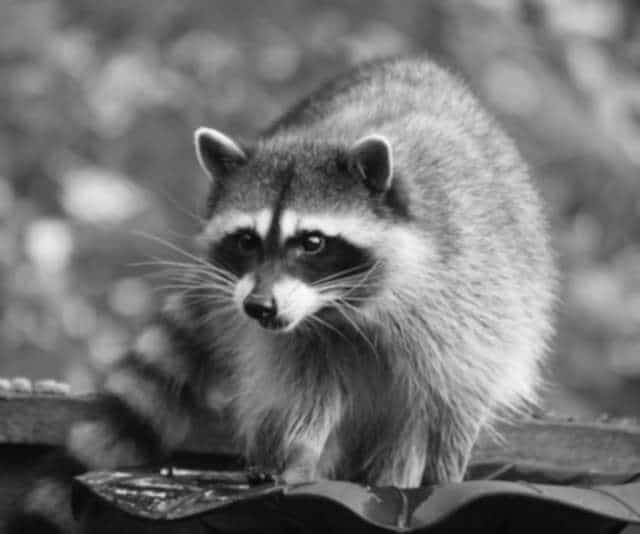
Raccoons are Ontario's most common urban wildlife intruder. They favour attics and chimneys for denning, especially in late winter and early spring when females seek a sheltered spot to give birth. Heavy nighttime movement, scratching in the ceiling, and a strong odour from droppings are the most common signs. In April and May, a raccoon in the attic is often a mother with kits, so any spring removal has to account for the young first. We remove raccoons by live trapping only, with a licensed trapper on staff.
Raccoon removal: signs, kits, live trapping and preventionSquirrels
Grey squirrels are active year-round and typically get in through a damaged vent, a gap where a tree branch overhangs the roofline, or worn fascia board. Entry is usually opportunistic rather than strictly seasonal, though activity peaks in fall as they cache food and look for a warm place to nest for winter. Once inside they chew: wood, insulation and wiring included.
Squirrel removal: grey, red and flying squirrels in the atticSkunks
Skunks den under decks, sheds, and porches rather than inside the home itself, and their presence is usually obvious well before an inspection: the smell alone is often the first sign. They're generally non-aggressive unless cornered. Before a den is sealed, it has to be checked for young and confirmed empty, so no skunk is shut in under the structure. Activity peaks in late summer and September, when the year's young set out on their own and lawns get torn up by skunks digging for grubs.
Skunk removal: dens under decks, young and winter habitsBats
Bats roost in attics, wall voids and behind loose siding, usually getting in along the roofline. The signs are small dark droppings piling up below an entry point or across the attic floor, and bats leaving the roofline at dusk. Several Ontario species, the little brown myotis among them, are listed as endangered, so timing is set by the bats: one-way doors go in during April and early May, before pups are born, or from mid-September to the end of November, once the young can fly. From December to the end of March, bats hibernating in a building must not be shut out. Don’t touch a bat, and if one has been in a room where someone was sleeping, call your local public health unit.
Bat removal: Ontario's exclusion dates, rabies and cleanupOpossums
The Virginia opossum, Canada's only marsupial, is a fairly new arrival in Ontario and is now relatively common in Toronto's larger parks and ravines. It is about the size of a house cat, grey with a whitish face and a bare, rat-like tail, and it mostly comes out at night. Opossums den under decks, porches and sheds, in garages and woodpiles, and a raided garbage bin, compost or bird feeder is a common sign. From late winter until late fall a female may be carrying young, so we check for them before the licensed trapper on our staff live-traps the opossum and releases it nearby. Then the way in is sealed.
Opossum removal: signs, young, live trapping and preventionGroundhogs
Groundhogs, also called woodchucks, dig in under decks, sheds, porches and front steps and along foundations, often next to a lawn or vegetable garden. Look for an open hole 25 to 30 cm across with a heap of soil beside it, and a stocky brown animal out by day. They sleep through the winter in the burrow and raise their young there in spring, so Ontario's advice is to move them out in late summer. We use a one-way door or live trapping, then bury wire mesh along the base.
Groundhog removal: burrows, young in spring, trapping and meshThe Legal Side of Wildlife Removal in Ontario
Wildlife removal in Ontario has legal limits, set by the Fish and Wildlife Conservation Act and its regulations. Ontario’s rules say a live-trapped animal has to be released within 1 km of where it was caught and within 24 hours, so driving it out to the countryside isn’t allowed. Several of Ontario’s bat species are listed as species at risk in Ontario, and most native birds are protected federally. The Protected Species in Ontario List includes seven Ontario snakes, and the milksnake and northern watersnake are specially protected reptiles in Ontario. These rules decide what can be done and when, and they’re the clearest reason not to trap and relocate an animal yourself.
BIRD CONTROL
Bird Control: Pigeons and Five Other Nuisance Birds
Pigeons look for sheltered, raised flat spots like balconies and rooftops. We keep them off condo balconies, ledges and signs with bird netting, spikes and sloped flashing, and clear out nests once any young have left. We also deal with sparrows and starlings in vents and signs, and put up deterrents for woodpeckers, gulls and Canada geese, which are federally protected, so their eggs and active nests stay untouched.
Pigeons on Condo Balconies, Ledges and Signs
Netting for balconies, spikes or 45 degree flashing for railings, ledges and sign tops, and nest removal once any young have left. In a condo, check with your board before anything goes up.
House Sparrows
Nests cleared from holes in signs and buildings once the young leave, then the hole closed.
Starlings
Nests cleared from vents once the young can fly, then a guard fitted that lets air and lint out.
Woodpeckers
Federally protected. Holes covered and netting hung once no nest is in use.
Gulls
Federally protected. Roof spikes, wire grids and HVAC netting, fitted before nests appear.
Canada Geese
Federally protected. Wire or rope grids over ponds and plantings; we never touch eggs.
Pigeon and bird control: balcony netting, condo rules and what the law allows for each bird
Tell us which bird and where it's getting in: choose Birds on the quote form.
Get a Free QuoteSNAKES
Snake Removal: Snakes in Basements, Garages and Yards
Ontario has 17 kinds of native snake, and only one, the Eastern Massasauga rattlesnake, is venomous. It lives around eastern Georgian Bay and the Bruce Peninsula, with two small populations near Port Colborne and Windsor, and not in the GTA. The snakes found in Toronto and Oakville basements, garages and yards are harmless gartersnakes, brownsnakes, red-bellied snakes and milksnakes.
Catch and release
When you ask us to, we catch the snake and release it within 24 hours, close to where it was found, and onto other land only with that owner's permission.
Cold weather
No snake goes outside in winter or below 12°C, as the City of Toronto advises.
Seal the way in
Once the snakes are out, we look for the gap they used, often in the foundation, and seal it.
Species at risk
We don't handle the Massasauga or any snake that is a species at risk in Ontario, and we point you to Ontario's species at risk page.
Snake removal: which snake it is, Ontario's only rattlesnake, catch and release and the law
Send us a photo on WhatsApp or tell us on the quote form where you saw it, and we'll tell you what the job involves.
Get a Free QuoteOUR PROCESS
How Our Wildlife Removal Works
- 1
Inspection
We identify the animal, find every entry point, and check whether there are young inside before any work starts.
- 2
Removal
Raccoons are caught in live traps set by our licensed trapper. Each is let go within 24 hours near its capture site (Ontario's rules say within 1 km), and only on land whose owner agrees. Sick, injured or orphaned animals go to an authorized wildlife rehabilitator. Squirrels, skunks and other animals leave through a one-way door where one works, or are live-trapped the same way. Bats leave only through one-way doors, in Ontario's exclusion windows.
- 3
Sealing Entry Points
Once the animal is out, every entry point is sealed with durable, gnaw-resistant materials.
- 4
Attic Cleanup
We remove droppings and soiled insulation and sanitize the area, so the smell leaves with the animal.
WHAT IT COSTS
What Affects the Cost of Wildlife Removal
The price depends on the job. These are the things that make one cost more than another.
The animal and the method
A one-way door and live trapping involve different numbers of visits, and some animals take longer to move out than others.
Entry points
How many there are and how hard they are to reach. A chimney or a second-storey roofline takes more work than a ground-level vent.
Young inside
In spring and summer, young in the attic change the timing and can add a visit.
Cleanup
Whether droppings and soiled insulation need removing, and how much.
Tell us what you’re seeing and we’ll tell you what the job involves.
FREE QUOTE
Get Your Free Quote
- 1Fill Form
- 2We Call You
- 3We Treat It
- 5 Star Google Rating
- Ontario-licensed exterminators
- No contracts, most calls returned within 1 hour during business hours